How Does Public Relations Help Companies Appear In AI Search Results?

 
black woman in yellow sweater - How does public relations help companies appear in AI search results?

Public relations helps companies appear in AI search results by creating content and building credibility through mentions in authoritative third-party sources, such as news outlets, podcasts and trade publications. AI models rely on trusted external data to generate answers. They look beyond keywords and websites and instead prioritize earned media, consistent messaging and structured content they can process and cite. When PR is done well, it establishes your brand as a reliable source AI systems feel confident referencing.

It also starts with great, fresh content that answers questions. PR is communication at its core, which is why PR teams are well-positioned to write content that is clear, accurate and ready to be referenced across the web.

For chief marketing officers and business owners, this shift changes how visibility is earned. Being discoverable now depends on what you publish about yourself and on what credible sources say about you.

Why do AI search tools rely on public relations signals?

AI systems summarize information rather than display ranked links. To do that, they pull from sources they recognize as accurate and independent.

Those sources include:

PR places your brand inside those environments, which AI models treat as trusted training data.

How does PR build trust and authority for AI systems?

AI models learn patterns. When your company appears repeatedly in respected outlets through interviews, quotes and features, the system begins to associate your brand with credibility.

PR builds trust by:

  • Securing consistent earned media mentions

  • Positioning executives as expert sources

  • Reinforcing the same message across multiple publications

Over time, this teaches AI tools that your brand is a dependable authority within its category.

How does PR shape what AI says about your brand?

AI summaries are influenced by the information already available across the web. If that information is inconsistent or incomplete, the output will be too.

PR shapes your brand narrative by:

  • Aligning messaging across earned and owned channels

  • Reinforcing accurate descriptions of your products and expertise

  • Reducing the likelihood of outdated or misleading summaries

This consistency helps AI systems present your company clearly and accurately.

Why does earned media acts as training data for AI models?

Executive interviews, contributed articles and podcast appearances provide context AI systems value. These formats explain who you are, what you do and why it matters in plain language.

Earned content works as training data because it:

  • Comes from third-party AI already trusts

  • Includes real explanations instead of marketing copy

  • Offers quotable statements AI can reuse

This is one reason executive visibility outperforms brand-only content.

How do press releases help with AI search visibility?

Press releases remain useful when they are written for clarity and structure rather than promotion.

Well-structured releases:

  • Follow predictable formats AI can parse

  • Reinforce consistent terminology

  • Serve as reference points for news coverage

When press releases lead to earned coverage, they strengthen AI recognition even further.

Why relevant mentions matter more than volume?

AI systems favor relevance over reach. A mention in the right trade publication often carries more weight than broad coverage in unrelated outlets.

PR drives relevant mentions by:

  • Targeting niche and industry-specific media

  • Securing analyst and expert commentary

  • Aligning placements with buyer search behavior

This ensures your brand appears in the conversations AI prioritizes.

What PR strategies improve AI visibility most?

Targeted media relations

Focus on outlets AI models frequently reference, including major news organizations and respected industry publications.

Thought leadership

Place executives in interviews and bylines that explain category challenges and solutions in clear terms.

Structured press releases

Use consistent language, clear headlines and factual framing to support AI ingestion.

Consistent brand story

Repeat the same positioning across earned and owned content so AI systems recognize patterns.

Crisis preparedness

Plan for how AI might summarize sensitive situations and have processes in place to correct inaccuracies quickly.
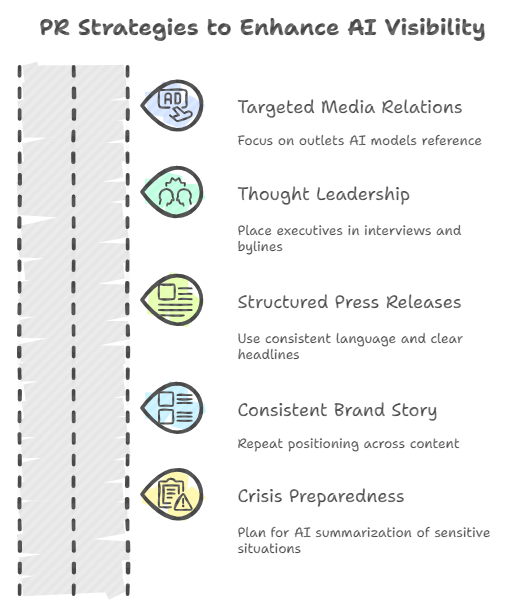
CHART FOR PR STRATEGIES TO ENHANCE AI VISIBILITY

How TrizCom PR supports AI search visibility

TrizCom PR helps middle-market companies strengthen AI discoverability through earned media strategy and executive positioning. Our approach focuses on placing brands inside trusted sources AI systems already use, reinforcing consistent narratives and producing structured content that supports accurate summaries.

Want your brand to show up in AI answers when buyers ask the questions?

When AI systems decide which brands to mention, they rely on trust, repetition and clarity. Public relations supplies all three by placing your expertise inside the sources AI already trusts.

If your company is investing in AI, content and visibility but still is not appearing in AI-generated answers, it is time to look beyond keywords. Strategic PR helps ensure your brand becomes part of the data AI uses to explain your category.

If you want to understand how your brand is currently represented in AI search results and what it would take to improve that visibility, talk with the team at TrizCom PR. A focused conversation can help you identify gaps, opportunities and a clear path to becoming a trusted source AI systems recognize and reference.

Frequently asked questions about PR and AI search

How long does it take PR to influence AI search results?

PR can quickly influence AI search results, especially when you consistently earn coverage (the opposite of SEO, which sometimes takes months to rank). Stronger citation patterns typically emerge after sustained placements across multiple authoritative sources, as AI systems respond to repetition in credible environments.

Can AI tools pull from press releases directly?

AI tools can pull from press releases directly, but press releases matter most when trusted outlets pick them up, reference them or use them as source material. A release that stays on your site often has less influence than a release that leads to third-party coverage.

Is PR more important than SEO for AI visibility?

PR is not more important than SEO for AI visibility because they do different jobs. PR builds trust and authority signals through third-party validation. SEO improves structure, crawlability and clarity on your owned channels. Most brands need both to show up reliably in AI answers.

Do podcasts and interviews help with AI search?

Yes, podcasts and interviews help with AI search because they provide context-rich explanations and quotable expert commentary. AI systems frequently reference interview-based content when it appears on platforms or publications they trust.

Does company size affect AI visibility?

No, company size does not affect AI visibility as much as authority signals do. AI systems tend to reward brands that show consistent expertise in credible sources. Middle-market companies often compete well when their executives are visible and their messaging stays consistent.

What types of outlets matter most for AI?

The outlets that matter most for AI are national business media, respected trade publications and analyst-driven platforms. These sources tend to carry more weight because AI systems treat them as higher-confidence references.

Can inconsistent messaging hurt AI summaries?

Yes. Inconsistent messaging and conflicting numbers undermine AI summaries because AI systems struggle to determine accuracy. When your company is described differently across interviews, bylines, bios and coverage, AI outputs can become vague, outdated or outright incorrect.

How do you correct AI misinformation about a brand?

You correct AI misinformation about a brand by publishing clearer, more consistent information in sources AI trusts. That usually means reinforcing accurate details through earned media, executive commentary and updated owned content hubs that AI systems frequently reference.

Should executives be visible or should brands speak alone?

Executives should be visible because AI models rely heavily on human expertise signals. When executives are quoted, interviewed or published as authors, AI systems have more context to cite, which often leads to stronger brand attribution than brand-only messaging.

How do you measure AI search impact?

You measure AI search impact by tracking how often your brand is mentioned in AI tools and how accurately it is described. Look for patterns in brand mentions across platforms, referral traffic from AI sources and whether earned coverage lines up with what AI systems are summarizing.


Everyone has a story to tell. Let TrizCom PR tell yours.

Learn more
 
Jo Trizila, Founder & CEO, TrizCom Public Relations

Author

Jo Trizila, Founder & CEO, TrizCom Public Relations

Jo Trizila leads Dallas‑based TrizCom PR, an award‑winning digital public relations agency she founded in 2008. She has guided integrated PR programs for startups, middle‑market companies and national brands, with deep experience in crisis communications, expert positioning and data‑driven media strategy.

Jo is also the creator of Pitch PR, a press release distribution company and a frequent speaker on earned media ROI, including sessions at the Earned Media Mastery virtual summit.

For more information contact jo@trizcom.com or 214-242-9282.


What Is PR, SEO and AI Search Integration?

What Is PR, SEO and AI Search Integration?

Discover how PR enhances SEO to boost organic traffic, blending storytelling with analytical strategies for improved visibility and brand authority online.

How To Be A Podcast Guest

 
Smiling person wearing headphones at a desk with a microphone and laptop in a bright home studio, text overlay reads “How To Be A Podcast Guest.”


Podcast guesting is more than a nice conversation. It is a focused way to earn links, citations and attention that show up in organic search and AI answers. When you prepare like a pro and give the host clean assets, your language lands in titles, show notes and transcripts. That is where discovery happens. Pair each interview with a simple landing page, an edited transcript and a short promotion plan. One appearance can fuel weeks of content and a steady stream of qualified visitors. Below are 14 Q&A that will help you prep, perform and turn each episode into measurable results.

How to be a good podcast guest?

Show up prepared, present and helpful. Know the audience, the host’s style and the show’s recent topics. Bring one sharp angle, one story and one resource that matches the theme. Answer the question asked, not the one you wish was asked. Speak in tight, complete thoughts so editors can pull clean clips. Avoid jargon. Share one stat with a source. Mention the URL once early and once near the end. Respect time. Wear headphones. Use a decent mic. Close with gratitude and a clear next step for listeners. Then follow through on promotion. Hosts remember guests who make their job easy and bring value to their audience.

How to prepare for a podcast interview as a guest?

Listen to two recent episodes. Note the pacing, question patterns and segment transitions. Draft three talking points, three example stories and three quotable lines under 120 characters. Write your short bio in 40 words and 90 words. Confirm the episode title options, links and preferred anchor text. Test your mic, camera and lighting. Silence notifications. Place a glass of water nearby. Keep a one-page cheat sheet with your framework, stat with source and the short URL you will say on air. Share your media kit with the host 48 hours ahead. Show up five minutes early. Take a breath. Smile. Think conversation, not monologue.

Do I have to travel for my guest podcast?

Almost never. Most guest interviews happen remotely over Riverside, SquadCast or Zoom. You need a quiet room, a USB mic, closed-back headphones and stable internet. If a show records in studio and invites you in person, weigh the upside. Studio quality can be higher and the relationship building is real. If travel is not practical, ask for a remote slot. Offer to ship your headshot and B-roll photo to support promotion. The goal is a clear recording and a useful conversation. You do not need a plane ticket to deliver that.

Talk to TrizCom PR

Are podcasts videotaped?

Many are. Audio-only is still common, but more shows capture video for YouTube and clips. Assume cameras are on unless told otherwise. Frame your shot at eye level. Use natural light or a simple ring light. Neutral background. No noisy patterns. Wear solid colors. Avoid clacking jewelry. Look at the camera when you deliver your key line. Ask the host if they plan vertical clips so you can center yourself in frame. Video gives you more assets to repurpose. Treat it like a bonus, not an obstacle.

How can I use my podcast appearance in other content?

Think building blocks. Post the edited transcript on your site with H2s and internal links. Write a recap blog with the three takeaways and two links to commercial pages. Cut a 30 to 60 second clip and a carousel for social. Add the episode to your Media Room with a short description and the show logo. Pull one quote into your About page or a sales deck. Drop the link in onboarding emails and nurture sequences. Pitch a related reporter with a data angle you discussed. Schedule reshares at 30, 60 and 90 days. One interview can fuel weeks of content if you plan it.

Does Google index podcasts?

Yes, through the pages around them. Google crawls show notes, transcripts and episode pages. It also sees your site if you publish an edited transcript and a recap. Make those pages clean and structured. Use descriptive titles, H2s that match real questions and links to a resource and a proof page. If the show publishes on YouTube, that video can rank for queries too. The audio itself is not the hero. The surrounding text is. Give Google and AI systems clear language, consistent names and fast pages. That is how your episode gets found after release week.

How can I make my story memorable?

Anchor it to a moment. A date, a client scene, a number that snaps attention. Use a simple framework to organize the lesson. Problem, choice, outcome. Keep details concrete. One quote from a customer beats five adjectives. Name the tension and how you resolved it. Share one mistake you will not repeat. End with a practical step listeners can take today. Then deliver your short URL that ties directly to the story. People remember specifics, not slogans. Give them a reason to retell your story in one sentence.

What is a podcast tour?

A podcast tour is a focused run of guest appearances across several shows in a set window, all tied to one message or launch. Think six to 12 interviews over six to eight weeks. You bring one angle, one resource and a promotion plan that repeats. The value is momentum. Repetition helps your message stick. Links and mentions stack. Search and AI panels see consistent language. Plan the tour like a mini campaign with targets, assets, a landing page and KPIs. It is not spraying and praying. It is a tight sequence with purpose.

How do I prepare the podcast host?

Send a tidy media kit 48 hours before recording. Include a 40 and 90 word bio, correct name and title with pronunciation, three title options under 60 characters, five show note bullets, one sourced stat, your three-step framework, headshot, horizontal image and two links with preferred anchor text. Add your short URL, social handles and promotion commitments. Confirm tech, date, time zone and release timing. Share any topics to avoid and a landmine list if needed. Ask if they want sample questions or timestamps. The easier you make it to copy and paste, the more your language lands on the page where it can be found.

Learn more

Can you promote your podcast guest appearance?

Please do. Promotion helps the host and helps you. Day 0, post on LinkedIn and X with a quote from the host and tag the show. Day 2, share a 30 second clip with captions. Day 7, publish the recap blog and link it in comments. Add the episode to your Media page. Email your list with three takeaways and one CTA. Share the short URL in sales follow ups. If budget allows, put a small paid boost behind the best clip to your warm audience. Promotion is part of being a good guest. Say yes to it.

Should I leave a review after my podcast appearance?

If the show asks, yes. Keep it honest and short. Thank the host by name, note one specific thing you enjoyed and mention the audience you think will benefit. Do not pitch your product in the review. Share the episode link in your channels and tag the show. A thoughtful review, a social post and timely promotion build goodwill. Goodwill turns into future invites and referrals. In podcasting, relationships travel farther than hype.

How can a podcast help with my SEO?

Podcasts help when you treat each appearance like a content asset. Show notes on reputable sites link back to your pages, which can lift rankings. Publish an edited transcript on your site with clear H2s that match real questions. Add a short summary, one sourced stat and links to a resource page and a proof page. Create a focused landing page for listeners with one primary CTA and a brief FAQ. Interlink the transcript and recap blog to your services and case studies. Make pages fast on mobile and easy to scan. Schedule a few reshares over 30, 60 and 90 days. The result is simple. More quality links, more crawlable text and a steady stream of visitors who already care.

Will my podcast interview show up on AI search results?

It can, if the surrounding signals are clean. AI systems cite pages with clear entities, consistent names and readable structure. Ask the host to include your preferred name, title and links in the show notes. On your site, post a transcript with headings tied to real queries, plus a short summary. Keep product names and phrasing consistent across bios, notes and the landing page. If there is video on YouTube, add a solid description with the same language. These steps help models understand who you are and what you said. You will not control when you are cited, but you can raise the odds by making your content easy to parse and easy to trust.

What equipment do I need to be a podcast guest?

Here’s the simple kit that works:

Quick setup tips:

  • Put the mic four to six inches from your mouth, use a pop filter if you have one

  • Turn off notifications and HVAC noise

  • Keep water nearby and notes at eye level

  • Share your short URL and bio with the host before you join

Clean audio, steady internet and a calm room beat fancy gear every time.

Make the momentum last

Treat every guest spot like a mini launch. Pick the right rooms, bring one clear angle and make it easy for the host to showcase your story. Publish fast, link smart and promote on a simple cadence. Do this on repeat and you build authority that shows up in blue links and AI summaries. If you want a plan that turns interviews into measurable results, TrizCom PR can help.

Everyone has a story. Let TrizCom PR tell yours!

Jo Trizila smiling in a red blazer standing by a column; graphic text on red background reads “Jo Trizila TrizCom PR & Pitch PR.”

About the Author:

Jo Trizila – Founder & CEO of TrizCom PR

Jo Trizila is the founder and CEO of TrizCom PR, a leading Dallas-based public relations firm known for delivering strategic communications that drive business growth and enhance brand reputations as well as Pitch PR, a press release distribution agency. With over 25 years of experience in PR and marketing, Jo has helped countless organizations navigate complex communication challenges, ranging from crisis management to brand storytelling. Under her leadership, TrizCom PR has earned recognition for its results-driven approach, combining traditional and integrated digital strategies to deliver impactful, measurable outcomes for clients across various industries, including healthcare, technology and nonprofit sectors. Jo is passionate about helping businesses amplify their voices and connect with audiences meaningfully. Her hands-on approach and commitment to excellence have established TrizCom PR as a trusted partner for companies seeking to elevate their brand and achieve lasting success. Contact Jo at jo@TrizCom.com.


Should You Still Blog When AI Answers Most Questions Today?


Split graphic showing a human profile bisected down the middle. Left side white labeled “AI Organic Search.” Right side dark labeled “Organic Search.” Header reads “Does Blogging Still Matter?”

If AI answers everything, why blog?

AI and Google pull from what already exists. I’m going to repeat that, AI and Google pull from what already exists. If your expertise is not on the page, it is not in the results. A steady, useful blog does four jobs at once: earns search visibility, feeds AI overviews with clean facts, arms sales with links that answer real questions and gives reporters quotable lines they trust. Blogging is not a journal. It is a library of answers your customer needs.

When readers land on your site, they want clarity fast. Your blog is the place to explain key ideas, show proof and offer next steps in one visit. Done well, each post becomes an asset that works long after publish day.

“Blogging is not a journal. It is a library of answers your customer needs.”

This blog walks through the why, the how and the proof so you can decide with confidence.

What you will learn

  • Why blogging still matters when AI answers quickly

  • How to use user intent keywords to match what people actually want

  • The signals AI and Google reward and how to bake them into every post

  • A cadence plan you can keep without burning out

  • Content formats that teach, compare, prove and convert

  • Where AI can speed the work and where humans protect voice and facts

AI search vs search engines. Who is winning

AI-powered search tools like ChatGPT and Perplexity are gaining ground. People use them for quick answers, summaries and idea starters. Growth is real and conversational results feel efficient for narrow tasks. Even with that momentum, traditional search engines still carry most of the daily traffic. For broad discovery, shopping and research across many sources, Google and Bing remain the first stop for most users. The behavior shift is visible, but it has not replaced classic search.

What this means for content is simple. Plan for both patterns. Write posts that answer the core question in the first screen, then expand with steps, tables and FAQs that AI can cite cleanly. Keep facts up to date, name entities clearly and link to related guides, pricing and case studies. Use Article schema and add FAQ or How-Tos when they fit. This approach helps posts rank in search while making them easy for AI to reference accurately.

Net: it is not either or. Plan content that can rank in search and be cited cleanly by AI.

AI Search VS Organic Web Traffic Statistics

  • Roughly 60% of Google searches now end with no click to a website (so-called zero-click results). Search Engine Land

  • Zero-click share has risen year over year; one analysis shows increases across the U.S., EU and UK in 2025.  Search Engine Land

  • For queries that trigger AI Overviews, the average CTR on the #1 organic result fell from 7.3% to 2.6% year over year, a ~65% relative drop in clicks to that top listing. Digital Content Next

  • Consulting research estimates 15–25% reductions in organic site traffic attributable to zero-click/AI summary behavior across categories. Bain

  • News publishers show the sharpest impact: some report traffic declines up to 40% since AI Overviews rolled out, with zero-click rates in news rising from 56% to 69%. (Impact varies by outlet; Google disputes parts of these studies.) New York Post

What is SEO and how can PR help?

SEO is the practice of making your site easy to find and trust in search results. It mixes clear content, technical basics like speed and mobile and links from reputable sites. PR strengthens SEO by earning credible mentions and backlinks from news outlets, trade media and quality blogs. Those links act like votes of confidence that lift rankings. PR also builds entity authority with consistent names for people, products and locations, which helps search engines connect your brand to key topics. Strong PR assets make better SEO pages too: quotable spokespeople, verified stats, case studies and images with alt text. Add article, FAQ or How-To schema, keep facts dated and link posts to service, pricing and case study pages. When PR and SEO plan topics together, you win both awareness and qualified traffic.

What is LLM and how can PR help?

A large language model is AI that predicts words to answer questions or create text. It relies on patterns learned from public content and favors recent, structured and trustworthy sources when citing. PR helps LLM visibility by publishing quality content worth citing. Think clear definitions, timelines, data tables and FAQs that answer in the first 150 words. Use consistent entity names, author bios, dates and linked sources. Mark up pages with article plus FAQ or How-To schema. Place quotable lines and short summaries that models can lift cleanly. Distribute those assets through earned media, partner sites and bylines to broaden trusted signals and links. Monitor common AI answers to your core queries, then fill gaps with new explainers, comparisons and case studies. In short, PR produces the credible source material LLMs look for and keeps it current.

The data that ends the debate

Neil Patel’s team compared 20 companies over 12 months. Ten kept publishing. Ten stopped. The gap was clear.

Neil Patel's blogging chart

Two takeaways:

  • Pausing a blog accelerates organic decline. Teams that stopped saw more than double the SEO (search engine optimization) drop.

  • Consistent publishing correlates with large LLM gains and real revenue lift.

Why this happens:

  • Fresh, structured, sourced articles send the signals search engines and AI systems use to rank, cite and recommend.

  • When publishing stalls, those signals fade. Competitors fill the gap with newer, clearer content.

The lesson is simple. Keep publishing on a schedule, keep posts current and keep structure tight. Momentum compounds when your content stays fresh and useful.

Source: Neil Patel email, Oct 29, 2025.

Email our team

Signals AI and Google reward

Search engines and AI tools reward content that feels recent, credible and easy to scan. Think of each post as a product. Label it, package it and make the value obvious from the first paragraph.

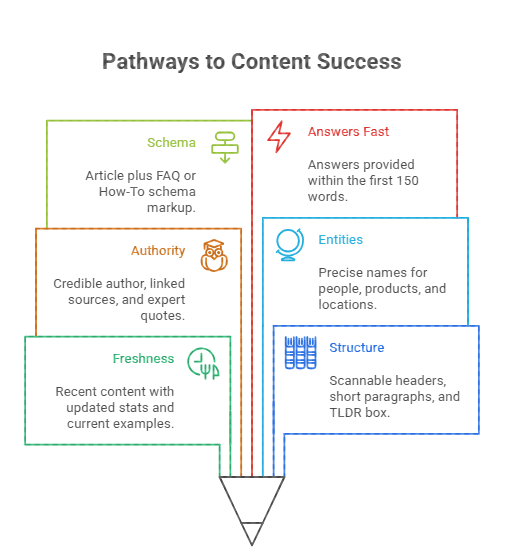
  • Freshness: recent posts with clear dates, updated stats and current examples

  • Structure: scannable headers, short paragraphs, pull quotes, lists and a TLDR box up top

  • Authority: named author with credentials, sources linked, quotes from experts, first party data

  • Entities: precise names for people, products, locations and definitions of key terms

  • Schema: Article plus FAQ or How-To where it fits organization and person markup on your site

  • Answers fast: state the answer in the first 150 words and expand below

  • Internal links: point to related guides, pricing, case studies and service pages

  • Media assets: original charts, images with alt text, short clips and downloadable checklists

  • Consistency: a steady cadence that keeps signals flowing to search engines and AI systems

  • Experience: fast load, mobile friendly, clean design, no intrusive pop-ups

“Think of each post as a product. Label it, package it and make the value obvious from the first paragraph.”

When you ship posts that check these boxes, you make it easier for readers to understand and easier for systems to surface your content. That is how rankings, citations and conversions move.

nfographic titled Pathways to Content Success. Six boxes feed into a pencil.

Write for your customer with user intent keywords

What are user intent keywords?

User intent keywords are the words and phrases people type or say that show what they want to do right now. They go beyond a topic and signal purpose: learn, compare, buy or navigate. Search engines exist to match that intent with the most relevant result.

Simple example:

If someone types Italian food, the results will likely feature restaurants. That query reads like a place or cuisine search. If the person types Italian recipes or how to make lasagna, the results shift to step-by-step guides and ingredient lists. Same subject, different intent.

How to write for your customer using user intent keywords?

Start with the words your customers use. Pull phrases from sales calls, support tickets, social comments and onsite search. Real language beats guesswork.

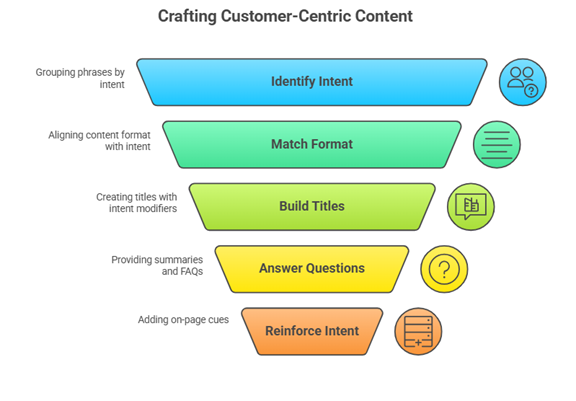
Group by intent:

  • Informational: what is, how to, pros cons, cost to

  • Comparative: vs, best for, alternative to

  • Transactional: pricing, demo, near me, book

  • Navigational: brand terms like login, case studies

  • Local: service + city, neighborhoods, landmarks

Match format to intent:

  • Informational -> explainers, checklists, FAQs, glossaries

  • Comparative -> X vs Y tables, scorecards, decision guides

  • Transactional -> pricing pages, ROI calculators, implementation timelines

  • Local -> city pages with service details, maps, local testimonials

Build titles and H2s with intent modifiers:

  • Pair the topic with a verb or outcome

    • Franchise PR pricing guide

    • Media training checklist for first TV interview

    • Integrated marketing examples for multi-location brands

Answer the next question:

  • Add a summary at the top, a quick table and a short What’s next box

  • Include three to five FAQs that mirror People Also Ask phrasing

On-page cues that reinforce intent:

  • First paragraph answers the core task

  • One table or list per post for skimming

  • Internal links guide readers to the next stage in the journey

  • Apply FAQ or How-To schema when it supports the page

Infographic titled Crafting Customer-Centric Content showing a five-step funnel

Quick checklist:

  • Who is this for and what are they trying to do

  • Primary intent plus 2 or three modifiers

  • One clear outcome promised in the title

  • Answer visible without scrolling

  • One data point, one example, one CTA that matches the intent

Writing to intent keeps posts useful and discoverable. It also helps sales and support point customers to the right answer without extra back and forth.

Cadence plan that teams can keep

A calendar you can keep beats a burst that burns out. Pick a tier that fits your team and protect it.

Pick a tier and protect it:

  • Minimum viable: Two posts per month per service line

  • Healthy growth: one post per week

  • Aggressive: Two to three posts per week during launches or peak season

Use a 3:2:1 monthly mix:

  • Three evergreen explainers that target informational intent

  • Two timely POVs or newsjacks tied to current coverage

  • One conversion story such as a case study, comparison or pricing guide

Lock a publishing day:

  • Choose one weekday, publish at the same time and treat it like a standing meeting

Assign clear roles:

  • Owner sets topics and briefs

  • Writer drafts with sources and quotes

  • Editor checks facts, voice, links and schema

  • Publisher loads, optimizes and ships on time

Keep a two month runway:

  • Maintain at least six ready to publish drafts

  • Refresh one older post each month with new data, links and a short update note

Weekly rhythm:

  • Mon plan and pull voice of customer notes

  • Tue draft

  • Wed edit and add assets

  • Thu load CMS, internal links, schema

  • Fri publish, distribute to email and social, log metrics

Consistency builds trust with readers and with search systems. Protect the cadence and the channel will start paying you back.

Get in touch

Content types that win across SEO and AI

Your blog works best when each post has a clear job. Mix formats that teach, compare, prove and guide. Use explainers to answer core questions, comparisons to help choices, case studies to show outcomes and checklists to drive action. This variety meets different intents, keeps readers engaged and gives search and AI systems clean signals to surface and cite.

Evergreen explainers

Define key terms, show steps, include a TLDR table and three to five FAQs.

Example: “Franchise PR explained” with a glossary and media list starter kit.

Decision guides and comparisons

Help readers choose with criteria, scorecards and pros and cons.

Example: “Media training agency vs DIY” with a cost and outcome table.

Pricing and timelines

Set expectations with ranges, factors and sample schedules.

Example: “How long does national TV take from pitch to air?” with a week-by-week plan.

Case studies with numbers

Lead with the outcome, then show the playbook and assets used.

Example: “How a regional launch earned 24 placements and three speaking invites.”

Questions hubs

Collect top customer and sales questions on one page, marked up with FAQ schema.

Example: “Crisis communications FAQ for franchise systems.”

Playbooks and checklists

Step-by-step, printable and linkable for journalists and partners.

Example: “First TV interview checklist” plus a one-page download.

Newsjacks and timely POVs

Add expert context to a breaking story with one chart and two quotes.

Example: “What the new local search update means for multi-location brands.”

Local intent pages

Blend service details with city-specific information, maps and local testimonials.

Example: “Media training in Dallas” with venue options and travel tips.

Original data and mini studies

Publish small, repeatable benchmarks or surveys.

Example: “Average response time from morning TV producers in Q1.”

How-to videos and short clips

Embed a 60 to 120-second walkthrough with captions and a transcript.

Example: “How to build a spokesperson one-liner.”

What to include in every post:

  • Clear summary up top

  • One table or checklist

  • Sources, dates and named author

  • Internal links to related guides, pricing and case studies

  • Article schema plus FAQ or How-To when it fits

  • A next step that matches the reader’s intent

The mix above creates a library that works across search, AI summaries, media outreach and sales enablement. Each post has a job and a place in the journey.

AI assist playbook that saves time without losing voice

AI speeds up the work. Your team supplies the thinking. Use AI where it removes friction and keeps humans on strategy, accuracy and tone.

Where AI helps:

  • Research sweep: expand topics, questions, related entities, common objections

  • Outline drafts: headings, talking points, FAQ ideas, table structures

  • Language variants: title and meta options, pull quotes, social snippets

  • On-page SEO: internal link suggestions, alt text drafts, FAQ and How-To starters

  • Schema scaffolding: Article, FAQ, How-To fields to hand to the CMS

  • Repurposing: turn a post into a byline, newsletter blurb, two short videos

AI Guardrails:

  • Fact check every stat and date

  • Cite sources with links and names

  • Keep brand voice. Edit for tone and clarity

  • Run a quick originality check

  • Avoid filler. Add first party data, examples, quotes

  • Label images and charts with plain alt text

Chat GPT PR Prompt recipes for blogs:

  • Outline: “Give me an H2/H3 outline for [topic] for [audience]. Include a TLDR table, five FAQs and one short case example.”

  • Title set: “Write 10 titles with the primary intent [informational/comparative/transactional] and the outcome [result]. 55 to 60 characters. (including spaces)”

  • Internal links: “From this post, suggest eight internal links to these URLs grouped by stage [top, middle, bottom]. Give anchor text ideas.”

  • Schema: “Draft minimal JSON LD for Article plus FAQ with these questions and answers. No fluff.”

Quality checklist:

  • Answer in the first 150 words

  • At least one table or checklist

  • Two internal links in, two out

  • One quote or data point we can verify

  • Clear next step that matches the reader intent

Use AI as a co author that never ships without human review. That balance keeps quality high and speed manageable.

Why blogs fail

Blogs do not fail because the channel is broken. They fail because the work is unstructured, sporadic and disconnected from real questions. If you blog to check a box without a plan to repurpose, measure and refresh, the results will fade.

Common failure patterns

  • No clear audience or intent per post

  • Topics chosen by guesswork, not voice of customer

  • Irregular cadence that resets momentum

  • Walls of text with no summary, table or FAQs

  • Thin content that repeats competitors with no data or examples

  • Missing schema, slow mobile pages, weak internal links

  • No repurposing into email, social, sales decks or bylines

  • No refresh cycle or scorecard tied to outcomes

How to turn it around

  • Define audience, intent and outcome before drafting

  • Lock a publish day and a 3:2:1 monthly mix

  • Add a TLDR, one table and 3 to 5 FAQs to every post

  • Mark up Article plus FAQ or How-To where it fits

  • Repurpose each post into two channels and refresh one post monthly

  • Track entrances, citations, links and assisted conversions

Publish answers AI and search engines can trust that people can use

If AI answers everything, your job is to give it something accurate to cite and give people something useful to read. Keep the cadence, write to intent and package each post so value is obvious in the first scroll. When the library grows, search lifts, sales get better links and reporters find clean quotes. Ready to put this system to work?

An example of the power of blogs

At TrizCom PR, we deliberately shifted to publishing more owned content, including long-form blog posts. The effect is clear in Google Analytics. More than 60 percent of our organic website traffic now comes from keyword-optimized blog posts. The other 40 percent arrives through AI search that cites or summarizes those same posts.

Why this works

  • Posts are written to user intent, so answers appear in the first screen

  • Article plus FAQ or HowTo schema mirrors on page text

  • Internal links connect blogs to services, pricing, and case studies

  • We refresh older posts with new data and note the update

What we did next

We repurposed top performers into email, short video, and bylines, then linked everything back to the pillar posts. The result is steady nonbrand traffic, better qualified leads, and a content library that AI and search can trust.

TrizCom PR can help

If you want a blog that feeds SEO, AI search, sales and PR, we can run the full system or coach your team. We plan clusters, write human led posts, add structure AI can cite and report on what moves the business. Ready for a 90 day pilot that proves it. Reach out and let’s talk.

Everyone has a story. Let TrizCom PR tell yours!

Book a quick call
Promotional graphic with a smiling woman in a red blazer standing indoors; red panel reads ‘Jo Trizila’ and ‘TrizCom PR & Pitch PR.’”

About the Author:

Jo Trizila – Founder & CEO of TrizCom PR

Jo Trizila is the founder and CEO of TrizCom PR, a leading Dallas-based public relations firm known for delivering strategic communications that drive business growth and enhance brand reputations as well as Pitch PR, a press release distribution agency. With over 25 years of experience in PR and marketing, Jo has helped countless organizations navigate complex communication challenges, ranging from crisis management to brand storytelling. Under her leadership, TrizCom PR has earned recognition for its results-driven approach, combining traditional and integrated digital strategies to deliver impactful, measurable outcomes for clients across various industries, including healthcare, technology and nonprofit sectors. Jo is passionate about helping businesses amplify their voices and connect with audiences meaningfully. Her hands-on approach and commitment to excellence have established TrizCom PR as a trusted partner for companies seeking to elevate their brand and achieve lasting success. Contact Jo at jo@TrizCom.com.

AI Search and Blogging FAQ

How to use AI for blogs?

Use AI to speed planning and polish, not to replace judgment. Start with a brief that defines the audience, user intent and the outcome. Ask AI for an outline, title options, FAQs and a TLDR box. Use it to expand a research list, surface related entities and suggest internal links. Draft in your voice, then have AI propose meta descriptions, alt text and schema starters for Article and FAQ. Fact check every stat, add first party examples and cite sources with dates. Finish with a table or checklist and a clear next step. Repurpose the post into a byline, newsletter blurb and two short clips. Measure nonbrand entrances, assisted conversions and new links, then feed wins back into the brief.

Are blogs still a thing?

Yes. Blogs remain the easiest way to publish structured expertise that search engines and AI can understand and cite. A steady blog gives you a library of answers for customers, sales and reporters. What changed is how blogs work. Short intros, clear H2s, an upfront summary and one table or checklist help readers and machines. Add Article schema and use FAQ or How-to when it fits. Refresh older posts with new data and internal links. Plan a cadence you can keep, such as one post per week and track outcomes like nonbrand entrances and assisted conversions. Blogs that publish consistently, write to user intent and provide sources still perform.

SEO vs content quality writing.

It is not either or. Quality writing clarifies the answer for a human. SEO helps the right person find it. Start with user intent (also known as search intent), then write a plain language summary, followed by steps, examples and a small table. Add sources with dates, define people and products precisely and include internal links to the next logical page. Technical basics still matter: mobile speed, clean HTML, descriptive alt text and valid schema. If you have to choose, ship a clear, accurate post, then iterate with SEO improvements. The best results come from quality writing that is structured so search and AI can understand it.

Has AI killed SEO and blogging?

No. AI changed the playing field but did not remove the need for trusted sources. AI systems rely on published, structured and current content. If your expertise is not on the page, it will not be found or cited. What is different is format and cadence. Lead with the answer, add a TLDR box, use H2s that mirror real questions, include a table or checklist and provide sources. Add Article schema and consider a FAQ or How-to. Keep a weekly schedule and refresh older posts. Plan for both search and AI by writing posts that can rank and be quoted cleanly.

The power of frequently asked questions.

FAQs match how people search and how AI formats answers. Add three to five FAQs that mirror “People also ask” language. Keep answers short, factual and linked to deeper guides. Place FAQs near the bottom so the main narrative flows. Mark up the section with FAQ schema when the content is visible on the page. Good FAQs reduce support tickets, help sales answer objections and improve your odds of earning rich results and AI citations. Update FAQs when pricing, timelines or regulations change and link each answer to a next step such as a comparison, calculator or booking page.

What is a schema markup?

Schema markup is structured data that helps search engines understand your page. It is added as JSON-LD in the HTML and describes the content type and key properties. For blogs, start with Article. When the page contains real Q&A, add FAQ. For tutorials, consider How-to articles. Keep fields accurate and consistent with visible text. Include author, date, headline, description and mainEntity for FAQs. Proper schema improves eligibility for rich results and makes it easier for AI systems to parse and cite your content. Validate with Google’s Rich Results Test and update schema when the page changes.

Why are backlinks so important?

Backlinks are links from other sites to your pages. They signal trust, relevance and authority. High quality links from news outlets, trade media, universities and respected blogs help pages rank and can improve how often AI systems encounter your brand while training or retrieving. Earn links with useful assets: data tables, checklists, glossaries and clear definitions. PR helps by placing bylines, quotes and case studies that credit your site. Avoid buying links or using spam tactics. Focus on relevance, editorial context and sources that real readers use. Track new referring domains and link growth to priority pages.

What metrics to use to measure your blog’s success?

Measure visibility, engagement, authority and conversion. For visibility, track non-brand organic entrances, impressions, clicks, featured snippets and AI overview mentions. For engagement, monitor scroll depth to 75 percent, average engaged time and clicks on tables, downloads or jump links. For authority, watch new referring domains and internal links to service and pricing pages. For conversion, use assisted demo or contact submissions from blog paths and newsletter signups. Operationally, track publish-on-time rate, valid schema, and refreshes shipped. Review monthly, compare to a 90-day target and double down on formats and topics that create assisted conversions.

Can I use ChatGPT to write my blogs?

Yes, as an assistant. Use ChatGPT for outlines, title sets, FAQs, meta ideas and first drafts. Then apply Google’s EEAT framework to make the post worth ranking and citing.

  • Experience: add first-hand examples, screenshots, quotes from your team and lessons learned.

  • Expertise: name the author, include credentials and explain the why behind your advice.

  • Authoritativeness: link to reputable sources, publish case studies and earn mentions from trusted sites.

  • Trustworthiness: fact check dates and stats, disclose conflicts and keep policies and pricing current.

Keep the human voice. Edit for clarity and intent, not just keywords. Put the core answer in the first 150 words, add one table or checklist and include Article plus FAQ or How-to schema when it fits. Finish with internal links to related guides, pricing and case studies. AI speeds the work. EEAT earns results.

How can I repurpose blog content?

Here’s a simple, repeatable plan.

Start with a pillar

Pick a strong post. Add a TLDR, one table, FAQs, and clear next steps. That structure makes repurposing easier.

Break it into formats

  • Email: one-sentence hook, key takeaway, single CTA

  • Social: 4 to 6 posts with a pull quote, stat, or checklist item

  • Short video: 60–90 seconds that walks through the table or steps

  • Carousel or infographic: turn the table or FAQs into slides

  • Sales enablement: a one-page PDF summary and a short talk track

  • Webinar or live: outline becomes a 20-minute demo with Q&A

  • Byline: adapt into an opinion piece for trade media

  • FAQ hub: move the Q&A into your central FAQ with internal links

System and cadence

  • Repurpose within seven days of publication

  • Link every asset back to the pillar page

  • Track nonbrand entrances, saves, shares, and assisted conversions

  • Refresh the pillar quarterly with new data and relaunch the set

Use AI to draft outlines and captions. Keep humans on voice, facts, and examples.

Is AIO (AI Optimization) and SEO the same?

No. They overlap, but they are not the same.

SEO makes your pages easy to find and trust in classic search. It focuses on user intent, clear structure, fast pages, internal links, schema, and earning quality backlinks.

AIO (AI optimization) makes your pages easy for AI systems to parse, quote, and cite. It favors upfront answers, TLDR boxes, precise entities, dated sources, FAQ or How-to patterns, and clean JSON-LD that mirrors on-page text.

How they work together

  • Lead with the answer in the first 150 words

  • Use H2s that match real questions

  • Include one table or checklist per post

  • Add Article plus FAQ or How-to schema when it fits

  • Name the author, add credentials, and link sources with dates

  • Build internal links to pricing, case studies, and guides

Result: SEO helps people find you. AIO helps AI cite you. Do both.

Let’s get started


Win the AI Search Game with PR Strategies for Modern CMOs

 
person typing on a laptop computer with Chat AI superimposed for AI Search

The search engine landscape is evolving rapidly. AI search is no longer a future concept—it's actively transforming how users interact with platforms like Google. For PR professionals, this shift necessitates a reevaluation of how content is discovered, evaluated and engaged with.​

According to Pew Research discovered that of February 2024, 23% of U.S. adults reported having used ChatGPT, up from 18% in July 2023. This increase suggests a rising familiarity and comfort with AI tools among the American public. The rapid adoption of AI-driven interfaces highlights how users are increasingly leaning towards AI-enhanced experiences, even when seeking information.

Traditional press releases, blog posts and media pitches are no longer sufficient on their own. To remain visible, credible and relevant, PR content must be optimized not just for human audiences but also for AI algorithms.​

Let's explore what's changing and how PR professionals can adapt.

What is AI Search?

AI search integrates artificial intelligence—particularly machine learning and natural language processing—into search engines to deliver more intuitive, conversational and accurate results. Unlike traditional search, which relies heavily on keyword matching and link-based algorithms, AI search interprets context, intent and relationships between topics to generate synthesized responses.​

How Does It Work?

  • Natural Language Understanding (NLU): AI search engines comprehend questions the way a human might ask them, focusing on the meaning behind a query rather than matching exact keywords.​

  • Generative AI: Tools like Google's Search Generative Experience (SGE) use AI models to pull information from multiple sources, summarizing it into a cohesive answer at the top of the search page.​

  • Continuous Learning: AI systems improve over time, learning from user interactions to refine how they rank sources and generate summaries.​

Think of AI search as a blend of a search engine and a knowledgeable assistant. Instead of providing a list of links, it offers a curated response, pulling from various reputable sources to deliver the best possible answer.​

 
Unlock AI-Driven PR Strategies
 

How AI Search is Transforming Google

AI search isn't just tweaking Google's algorithms; it's reshaping the entire user experience. Google's generative AI tools, like Search Generative Experience (SGE), synthesize information from multiple sources to provide direct answers at the top of search results. This means fewer clicks to individual websites and more emphasis on summarizing information within the search engine itself.​

According to Avenue Z, AI-driven search engines now present conversational, synthesized answers, prioritizing concise, context-rich content. The traditional blue links are being pushed down the page. With this evolution, PR teams must consider how their stories and key messages will surface in these AI-generated snippets.​

Google search screenshot for AI Search

As Forbes notes, "If you're not optimized for AI search, you're invisible." The days of optimizing only for keywords and backlinks are over. Now, PR content must be contextually rich, authoritative and aligned with how AI interprets and generates information.​

What This Means for PR and PR Content

1. Authority Matters More Than Ever

AI search prioritizes trusted sources. Publications with strong reputations and authors with demonstrable expertise are more likely to be referenced in AI-generated results.​

For PR professionals, this reinforces the importance of earned media placements in credible outlets. If your client's story lands in a well-regarded publication, it has a higher chance of being surfaced by AI search. At TrizCom PR, we've always believed in the value of building strong media relationships—this shift makes that mission even more essential.​

2. Contextual Content is Key

AI search tools don't just pull exact keyword matches; they synthesize context across multiple data points. This means your content needs to be comprehensive, clear and aligned with user intent. Press releases and thought leadership pieces must answer the "why" behind the story, not just present the facts.​

For example, if you're promoting a client's new sustainable product, your content should touch on industry trends, environmental impact and consumer benefits—all areas an AI engine might aggregate into a broader response.​

3. Structured Data Gives You an Edge

Behind-the-scenes SEO practices like structured data markup help AI understand the context and credibility of your content. Think of schema markup as a translator between your website and search engines, signaling what your content is about and why it matters.​

Embedding structured data in press releases, case studies and blog posts increases the chances that AI search tools will recognize and feature your content. It's one of those small adjustments with outsized impact.​

4. Refresh and Repurpose Content

AI search favors fresh, relevant content. Regularly updating blog posts, press releases and media kits with new insights, statistics or case studies helps ensure your material remains part of the AI conversation.​

At TrizCom PR, we recommend auditing your content library quarterly. Assess what's performing well, what needs updating and which topics have gained momentum in your industry. These insights help guide content strategy in an AI-driven search environment.​

5. Visuals, Summaries and Snippets

Generative AI search tools often extract quick summaries or visual elements to present in search results. Including concise summaries, bullet points, infographics or videos in your PR content can make it more "AI-friendly."​

Consider adding key takeaway sections to blog posts or creating media kits with easy-to-digest statistics and visuals. The more accessible your content is for both human readers and AI, the better.​

 
Future-Proof Your PR Strategy
 

PR's Role in the Age of AI Search

The role of PR remains the same: crafting compelling stories and building trust. But how we deliver those stories—and how they're found—is evolving. In this AI search landscape, PR must work hand-in-hand with SEO, data analytics and digital content teams.​

Here's how TrizCom PR is helping brands stay visible:

  • Integrated Strategies: Combining earned media with optimized digital content that feeds AI search engines. This includes leveraging multimedia, using structured data, and ensuring that content is rich in context and relevance.

  • Data-Driven Insights: Using advanced analytics to track which content performs well in AI-driven search environments. We analyze user behavior, engagement metrics, and search patterns to refine our approach continuously.

  • Ongoing Education: Staying at the forefront of AI developments and training our team to understand new tools and algorithms. This proactive mindset helps us craft PR strategies that are ahead of the curve.

  • Building Authoritative Content: Prioritizing E-E-A-T (Experience, Expertise, Authoritativeness, and Trustworthiness) content, which AI search engines favor. We collaborate with subject matter experts to ensure our content reflects high levels of credibility and insight.

  • Adaptability: Regularly updating and repurposing content to stay relevant. Whether it’s a fresh angle on a familiar topic or new data supporting a client story, we make sure our content evolves along with AI search preferences.

Looking Ahead

AI search is still evolving, but one thing is clear: the lines between PR, content marketing, and SEO are blurring. At TrizCom PR, we see this as an opportunity. It’s a chance to amplify your brand’s story in new ways, ensuring it reaches the right audience—even when that audience is an algorithm.

By staying agile, leveraging data, and prioritizing high-quality content, we help brands not just keep up but lead in the evolving digital landscape.

Ready to make your PR content AI-search ready? Let’s start the conversation.


Want A Quick Summary?

Listen to TrizCom PR's NotebookLM recap with Chuck and Karen for the latest insights and key takeaways!

 
Boost Visibility with AI Search
 
Jo Trizila – Founder & CEO of TrizCom PR

About the Author:

Jo Trizila – Founder & CEO of TrizCom PR

Jo Trizila is the founder and CEO of TrizCom PR, a leading Dallas-based public relations firm known for delivering strategic communications that drive business growth and enhance brand reputations as well as Pitch PR, a press release distribution agency. With over 25 years of experience in PR and marketing, Jo has helped countless organizations navigate complex communication challenges, ranging from crisis management to brand storytelling. Under her leadership, TrizCom PR has earned recognition for its results-driven approach, combining traditional and integrated digital strategies to deliver impactful, measurable outcomes for clients across various industries, including healthcare, technology and nonprofit sectors. Jo is passionate about helping businesses amplify their voices and connect with audiences meaningfully. Her hands-on approach and commitment to excellence have established TrizCom PR as a trusted partner for companies seeking to elevate their brand and achieve lasting success. Contact Jo at jo@TrizCom.com.


Do Press Releases Help SEO? Benefits & Best Practices

Do Press Releases Help SEO? Benefits & Best Practices

This comprehensive guide explores the nuanced relationship between press releases and search engine optimization (SEO). While press releases can benefit SEO strategy, their effectiveness depends on strategic implementation and integration with broader digital marketing efforts.

Press releases contribute to SEO through multiple channels: they generate quality backlinks from media coverage, increase brand visibility in search results and drive referral traffic from authoritative sources. However, success requires following best practices, including crafting newsworthy content, optimizing for relevant keywords and distributing through reputable channels.

Key factors for success include:

  • Creating genuinely newsworthy content

  • Strategic keyword placement

  • Quality distribution networks

  • Integration with broader content marketing

  • Proper technical optimization

  • Natural link-building practices

The article emphasizes that press releases should complement, not replace, other SEO tactics. While Google's John Mueller confirms press releases don't directly boost rankings, their indirect benefits through media coverage and increased visibility make them valuable tools in a comprehensive digital marketing strategy.

Understanding this relationship helps businesses leverage press releases effectively while avoiding common pitfalls that could diminish their SEO impact.

Is PR Responsible for SEO Content? You Bet!

Is PR Responsible for SEO Content? You Bet!

This blog post explores why PR professionals are essential for creating effective SEO content. The article argues that modern PR teams combine traditional storytelling expertise with technical SEO knowledge to create content that both ranks well and engages audiences. It emphasizes that PR professionals excel at keyword research, particularly in identifying valuable long-tail keywords, due to their deep understanding of target audiences.

The piece highlights PR's unique ability to earn quality backlinks through media relationships, a critical ranking factor in search engines. It explains how PR teams optimize web pages, product pages, and landing pages while maintaining authentic brand voice and messaging. The article showcases how PR professionals use data analytics to track SEO performance and continuously improve content strategy.

Key takeaways include PR's role in:

  • Creating high-quality, authoritative content that search engines favor

  • Building natural backlinks through media relationships

  • Understanding and targeting user intent

  • Optimizing technical SEO elements while maintaining engaging narratives

  • Measuring and improving content performance through analytics

The article concludes with a call to action for TrizCom PR's services, positioning them as experts in combining PR expertise with SEO strategy for maximum digital visibility and engagement.

Why and How to Check Website Ranking for Marketing

Why and How to Check Website Ranking for Marketing

This comprehensive guide explores how to check website ranking effectively, a crucial skill for online success. It covers the importance of rankings, free and paid tools for monitoring, and strategies for improvement. The article discusses key concepts like search volume, SERP features, and the differences between desktop and mobile rankings. It emphasizes the need for regular rank checking and continuous optimization. The guide provides step-by-step instructions on using ranking tools and offers tips for interpreting results. It also touches on future trends in SEO and mobile optimization. Overall, this resource equips readers with the knowledge to track, analyze, and improve their website's search engine visibility, ultimately driving more organic traffic and business growth.

How to Increase Organic Search Traffic: A Guide for PR

How to Increase Organic Search Traffic: A Guide for PR highlights the crucial role of SEO in modern PR strategies. As client goals increasingly focus on website traffic, PR professionals must blend traditional skills with SEO expertise. The guide covers key areas including on-page optimization techniques for press releases and content, technical SEO for PR websites, and the importance of user experience. It emphasizes creating high-quality, newsworthy content that ranks well in search results, and leveraging digital PR for link building. The post also discusses measuring success through SEO metrics and tools. Ultimately, it argues that integrating SEO into PR practices is essential for success in the digital age, helping messages resonate with journalists, search engines, and target audiences alike.

How To Boost Site Traffic? PR: Your Secret Weapon

How To Boost Site Traffic? PR: Your Secret Weapon

his blog post explores how to boost site traffic using public relations strategies. It emphasizes PR as an often overlooked but powerful tool for increasing online visibility and driving organic traffic. The post introduces the PESO Model™ (Paid, Earned, Shared, and Owned media) as a comprehensive framework for implementing effective PR strategies.

Key points include:

  1. Understanding PR's role in digital strategy and its synergy with SEO

  2. The impact of PR on online visibility, search rankings, and brand authority

  3. Detailed explanations of each PESO component and how they contribute to traffic generation

  4. The importance of content creation and distribution in PR efforts

  5. Leveraging media coverage and backlinks to boost traffic

  6. Utilizing social media for PR and audience engagement

  7. The value of influencer partnerships in driving site traffic

The post highlights various PR tactics such as media relations, content creation, social media engagement, and thought leadership development. It also provides practical tips for implementing these strategies, such as building relationships with journalists, crafting compelling stories, and creating shareable content.

Overall, the blog emphasizes the integrated approach of PR in boosting site traffic, enhancing online presence, and building brand authority.